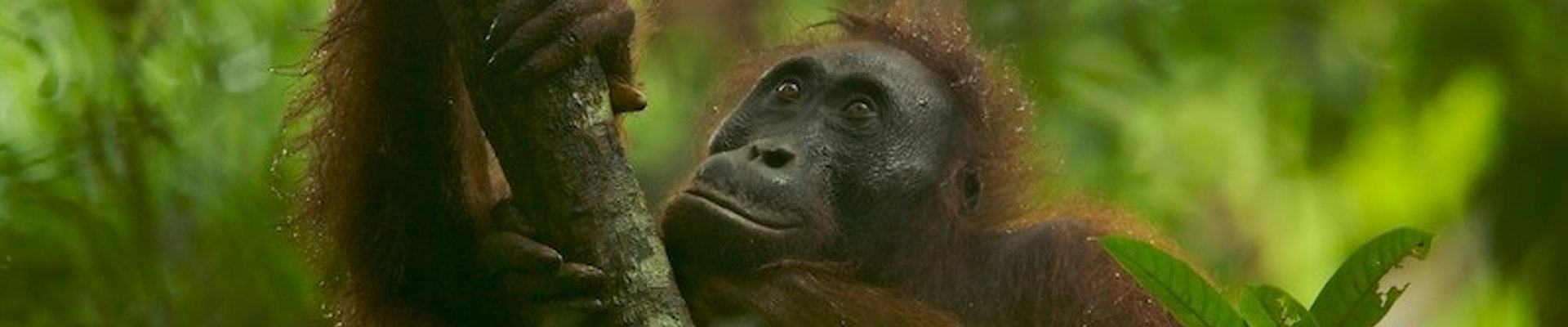
Gunung Palung Orangutan Conservation Program
Saving Critically Endangered Orangutans and their Forests
Found only on the forested islands of Borneo and Sumatra, the three species of orangutans are critically endangered. Making their home in fruiting canopies, their future is rooted in the survival of their forests. Those same forests are disappearing and becoming fragmented under pressures of human development and expanding agriculture, specifically palm oil, an additive that appears in 50% of our everyday groceries and toiletries.
Woodland Park Zoo partners with Gunung Palung Orangutan Conservation Program (GPOCP) dedicated to preserving Bornean orangutan populations and forest habitat in and around Gunung Palung National Park. Recognizing that most threats to orangutan survival are human induced, GPOCP strives to develop a human community that is aware and motivated to conserve and protect the orangutans, their habitat and the biodiversity within this rainforest. Since its inception, GPOCP has evolved into a landscape level conservation organization, working towards the protection of the park and surrounding ecological areas.
Over the course of three years, GPOCP worked with five local communities, assisting them in legally securing over 18,000 acres of orangutan and rainforest habitat, and turning over management of the land to their villages.
In 2017, GPOCP reported 10 cases of illegally held orangutans or human orangutan conflict to authorities, resulting in 8 rescues or confiscations.
Through a series of environmental education activities such as mobile cinema events, puppet shows and village discussions, over 5,800 students and youth learned more about living with orangutans.
GPOCP is working with villagers on creating and stocking small fish ponds as an economically efficient and sustainable non-timber related livelihood opportunity.
Changing habits takes practice. Start the switch to sustainable palm oil by using the candy guide to satisfy your sweet tooth. Then download the PalmOil Scan mobile app to easily scan barcodes while you shop and expand your wildlife-friendly habits to your lunchbox, your kitchen pantry, your bathroom cabinets and beyond.


Created by World Association of Zoos and Aquariums with Cheyenne Mountain Zoo
Orangutans are great apes—a family of primates that also includes all gorillas, chimpanzees, bonobos and humans. Every species of great ape, with the exception of humans, faces a risk of extinction and is listed as endangered or critically endangered. Orangutans are the most arboreal of all the great apes, meaning they spend most of their lives foraging, eating, sleeping and raising their young in tree canopies. They are native to the tropical forests of Indonesia and Malaysia and their survival is directly connected to the health of those forests.