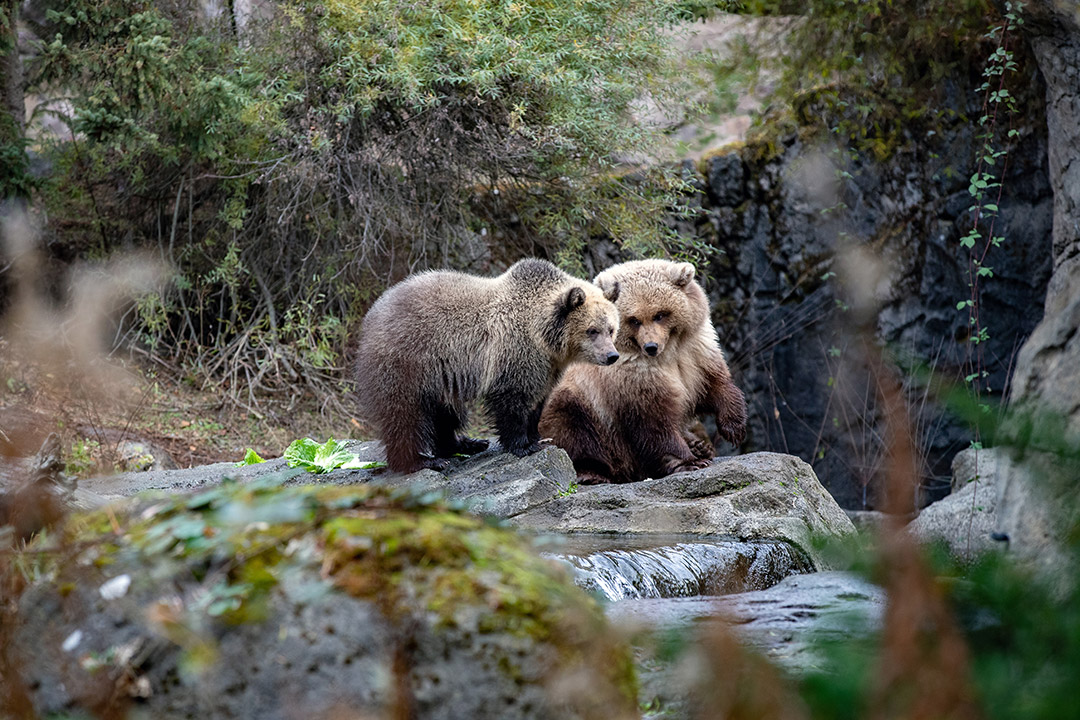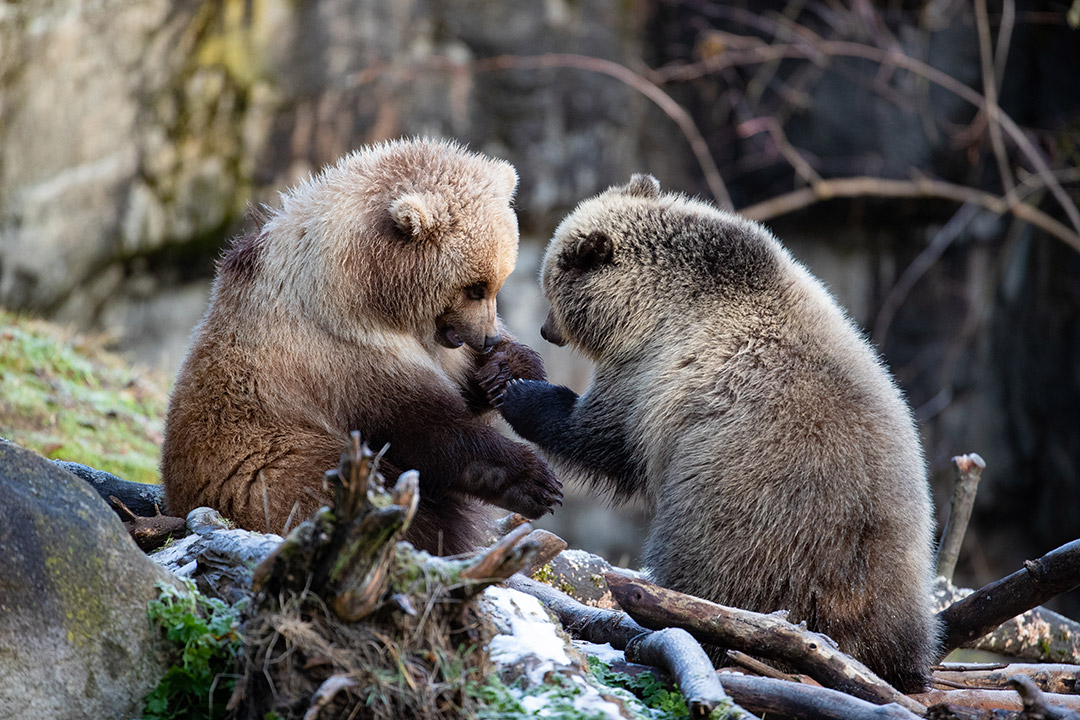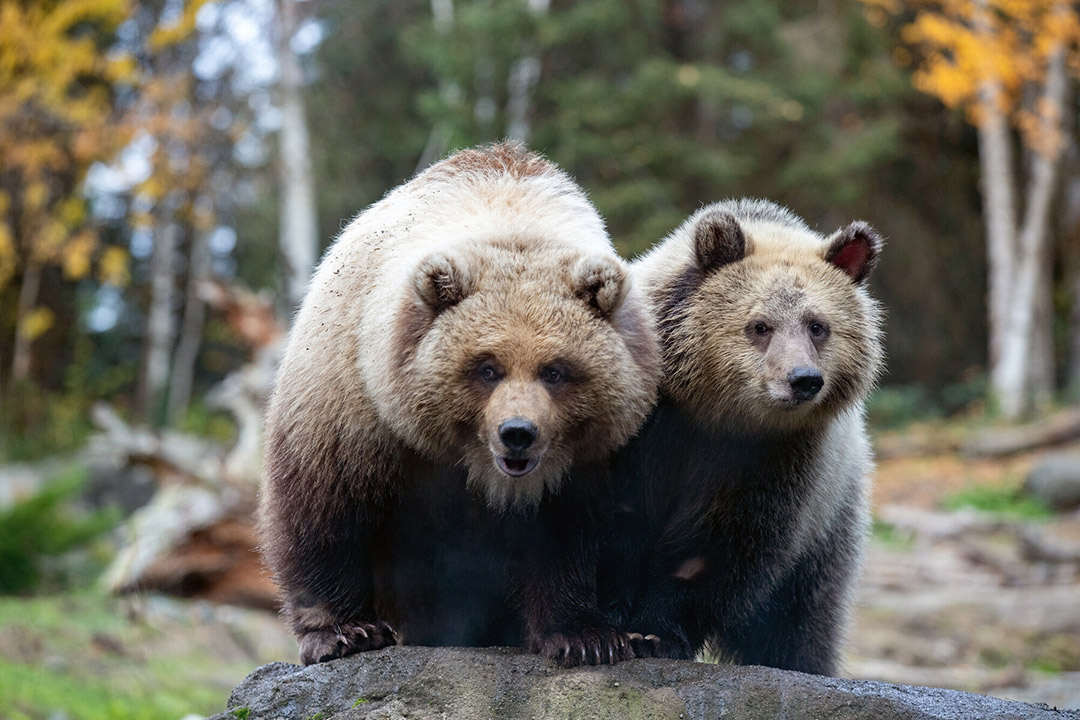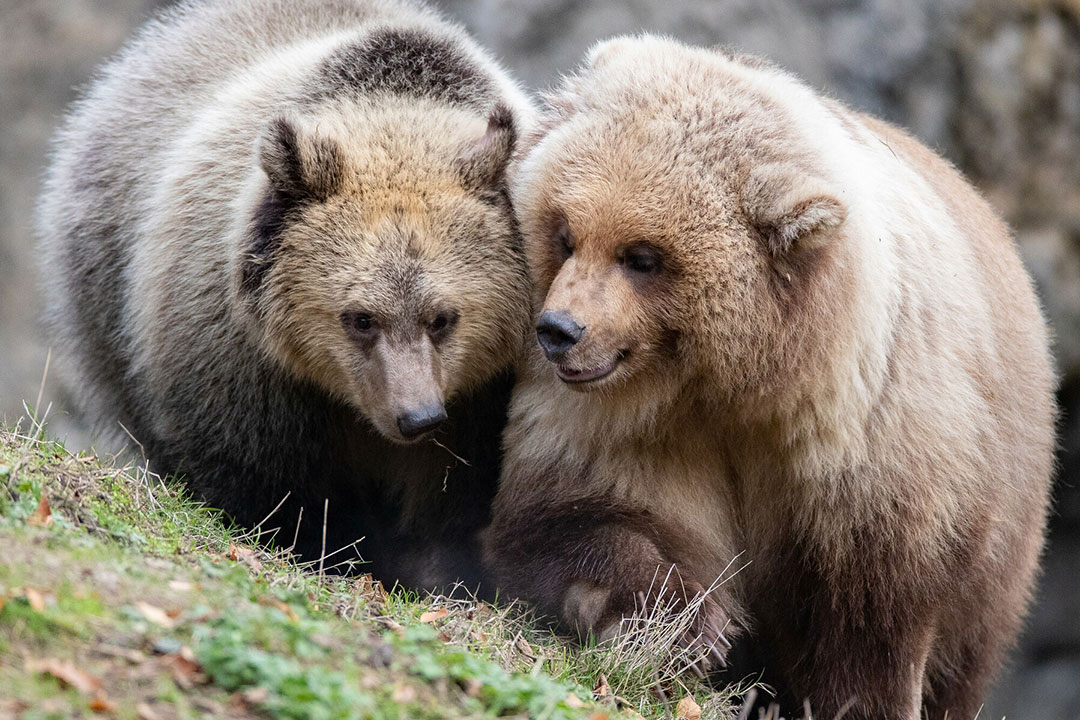
Brown Bear
(Ursus arctos)
Habitat
Brown
bears prefer mountain forest, tundra and coastal habitats.
Physical
Description
Brown bears have a head and body
length of 68-112 inches (173-284 cm), and their tail is 2.5-8.5
inches (6-22 cm) in length. Brown bears range from 209-1,716
pounds (95-780 kg) in weight. Adult males normally weigh more
than adult females. Coastal Kodiak bears, which feed on high-calorie
diet of salmon, can often reach 1,540 pounds (698 kg). Brown
bears residing in the interior primarily feed on lower calorie
diet of berries, vegetation and small mammals. The weights of
interior bears varies from about 330-794 pounds (150-360 kg)
in Alaska and British Columbia, to 209-306 pounds (95-139 kg)
in the Yukon Territory, to 224-714 pounds (102-324 kg) in Yellowstone
National Park.
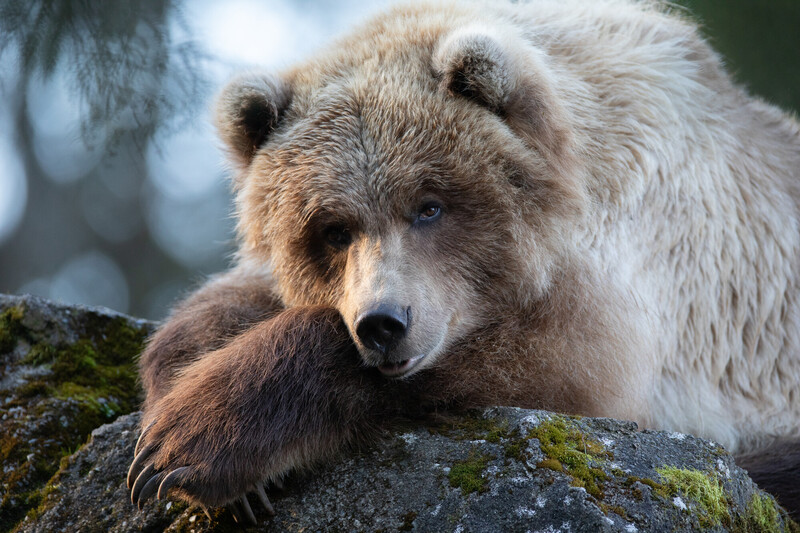
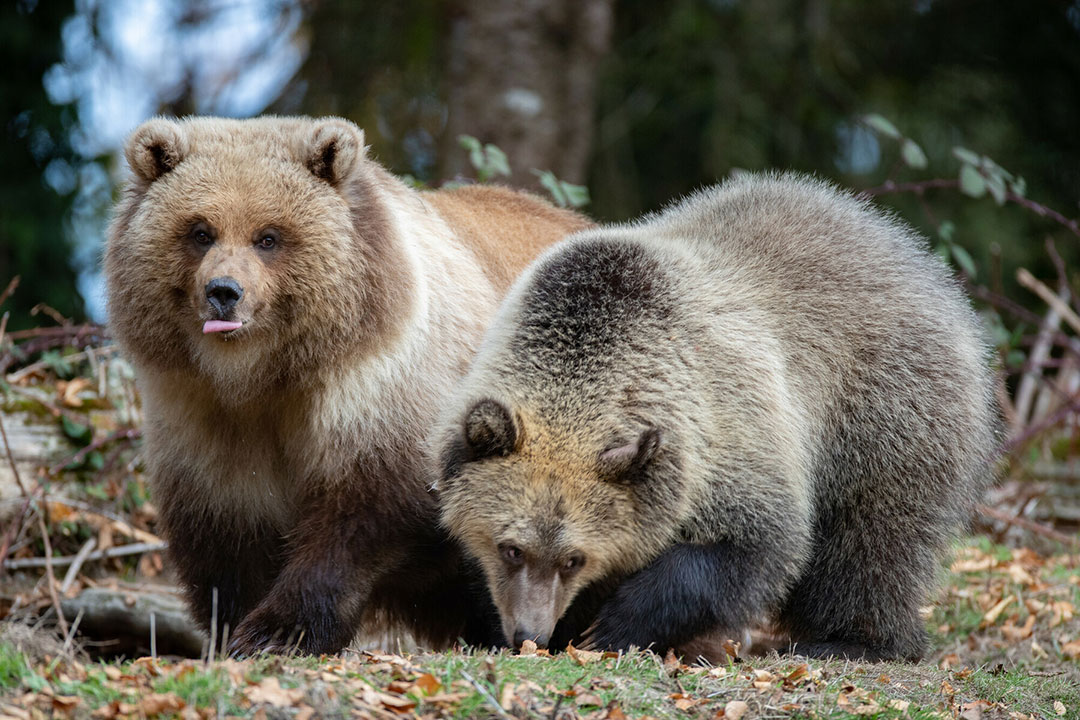
The fur of a brown bear has many
variations of color, from cream to cinnamon and brown to black. The
brown bear has a concave outline to the head and snout, small ears
on a massive head, and high shoulders that produce a sloping back line.
The bear's sense of smell is much more acute
than its hearing and sight.
Life
Span
20-25
years in the wild; somewhat longer in zoos
Diet
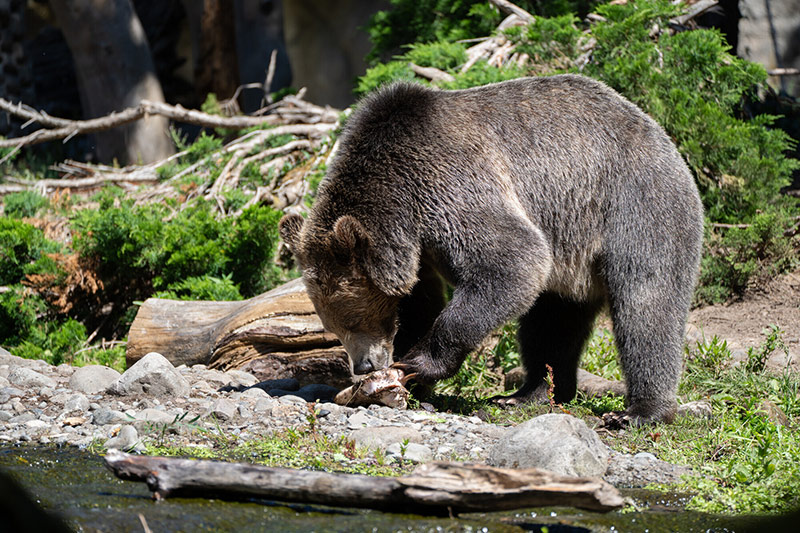
In the wild: Brown
bears are omnivorous and eat several different available plants and animals.
This includes herbs, tubers, berries, insect grubs, small rodents, salmon,
trout, carrion (dead animals), young hoofed animals (moose, elk, deer,
caribou) and occasionally livestock.
At the zoo: Canine diet, yams, carrots,
apples, oranges, romaine, celery, kale, omnivore biscuits,
leaf eater biscuits and bread
Reproduction
Breeding occurs
in May or June after two to 15 days of courtship. However, the fertilized
egg does not begin its embryonic stage of development inside the womb
until October or November. Bears give birth to the smallest of all mammalian
young in proportion to the size of the parent. The young are born helpless
and weigh about 13 ounces (369 g). Between January and March, the female
gives birth to two or three cubs. After birth, the cubs remain with their
mother up to four years (up to five in Alaska). The sow generally gives
birth to another litter the first spring after separating from her cubs.
Life Cycle
Under most circumstances,
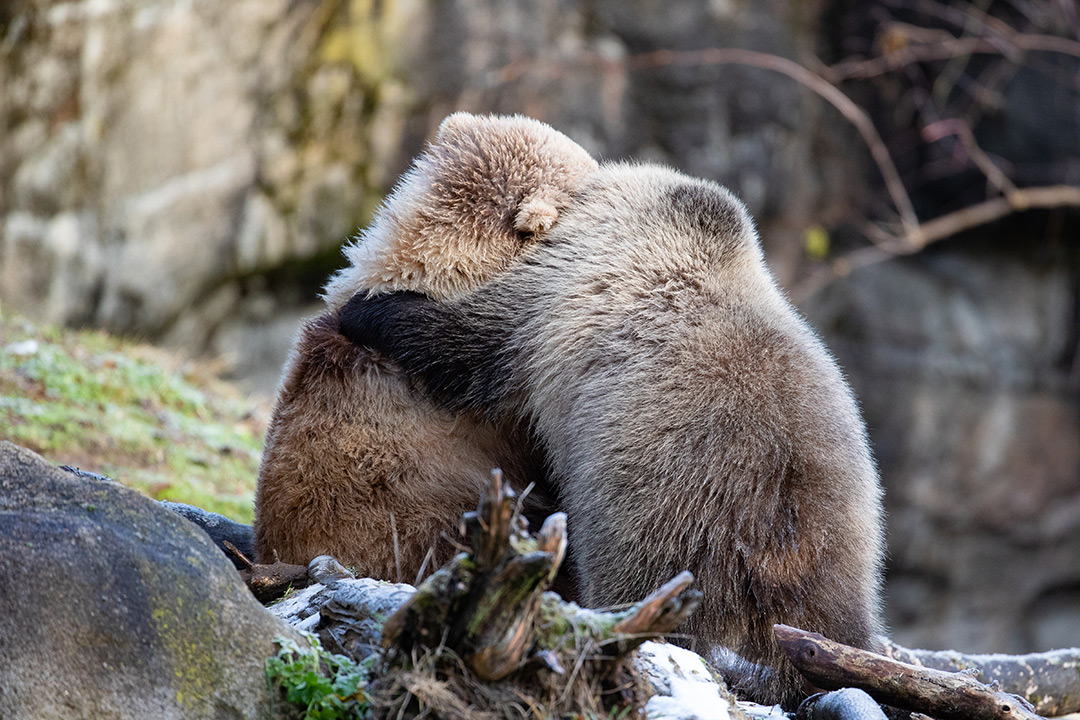
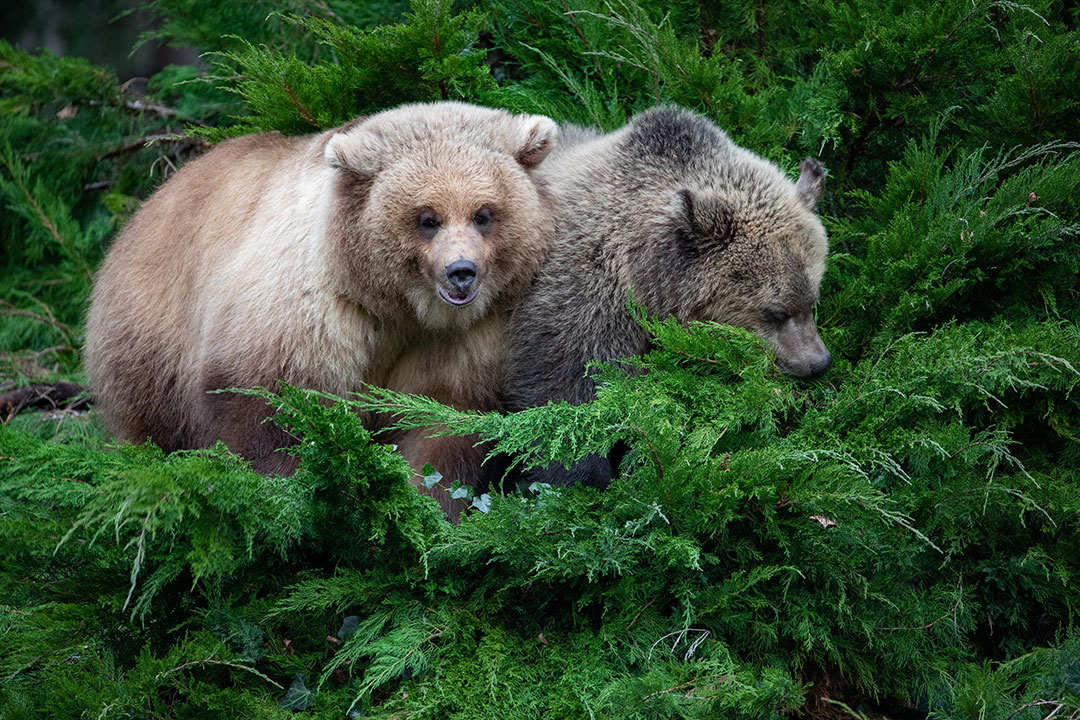
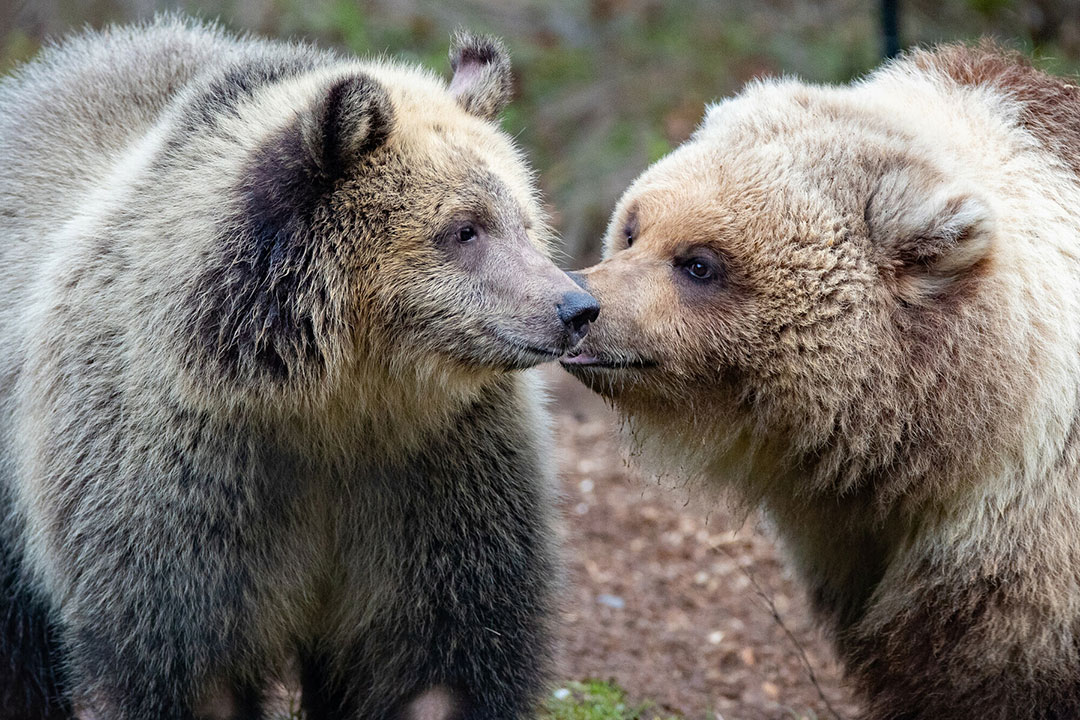
brown bears live as lone individuals, except for females accompanied by their
cubs. Siblings sometimes remain together for a while after separating from their
mother. Despite their propensity for solitary existence, brown bears congregate
where food is abundant, such as at salmon streams or garbage dumps.
Winter Rest
Bears experience
a period of dormancy beginning in November or December, ending in April or May.
They spend the dormancy period in their dens. Their body temperature drops, and
their general metabolic rate decreases as well. This is not considered complete
hibernation. They occasionally emerge from their dens to forage, particularly
during spells of warm weather or during years when food is scarce prior to denning.
Cubs are also born during the period of denning.
Are Brown Bears and Grizzly Bears the Same?
All grizzly bears (Ursus arctos
horribilis) are a subspecies of brown bears, but not all brown bears are
grizzly bears. Worldwide, brown bears are found throughout the northern hemisphere
in North America, Asia and Europe. The North American populations of brown bears
living in the interior portion of this continent are referred to as grizzly bears.
This distinguishes them from brown bears living on the coastal areas of Alaska.
As brown bears living in the interior become older, the ends of their hair tips
turn silvery-gray, giving them a “grizzled” appearance. Hence, the
reference to them as grizzly bears.
Are there any Grizzly Bears in Washington state?
Researchers suspect that grizzly bears
do live in Washington state. However, experts in animal tracking and wildlife
sciences can rarely get confirmed sightings. Research indicates that grizzly
bears likely live in the North Cascades and the northeast corner of the state,
wandering in and out of Canada.
Location
at the Zoo
The zoo's
two brown bears are grizzly bears. They can be viewed from a number
of locations within the Northern Trail. Several overlooks provide
fantastic views of the bears ambling over ground and through streams.
Two cave-like apertures offer a private view of the bears and their
pool. Inside the Taiga Viewing Shelter, visitors can watch the
bears swim in their pool and try to catch live trout. Woodland
Park Zoo has kept brown bears for nearly 100 years. During this
time, these bears have successfully raised 13 cubs.
Conservation Connection
Brown bears are listed as an endangered species in the countries of Bhutan,
Mongolia and China. The Washington State Department of Fish and
Wildlife also lists the brown bear as endangered. Brown bears are
considered threatened under the U.S. Endangered Species Act in the
lower 48 states. They are not protected in Alaska.
Brown bears inhabit less than 2% of their original range. Furthermore,
the current population is less than 2% of its original level. Today,
there are between 40,000 and 50,000 brown bears left in the wild. This
drop in numbers can be partially attributed to habitat loss and hunting.
Fear and ignorance of bears has led to their extermination. An increase
in the poaching of bears has also greatly affected bear populations.
Poachers harvest bear body parts to provide ingredients for traditional
Asian medicines. As a result of their low birth rate combined with
a high death rate of cubs (up to 50% mortality), brown bear populations
are not recovering from this dramaticdecline.
How Woodland Park Zoo Is Helping-With Your
Support!
Woodland Park Zoo supports several field-based
conservation projects that aim to help animals, plants and habitat in brown
bear's range. These include the Selkirk Grizzly Project, DNA research, and
the Grizzly Bear Outreach
Project (GBOP). For more information on our involvement with GBOP, visit that page in our Conservation section.
Since 1998, WPZ has provided funding to the Selkirk Ecosystem Grizzly
Bear Recovery Project. Grizzly bears in the Selkirk and Purcell Mountains
of northern Idaho and northeastern Washington represent one of the last six
remaining
grizzly bear populations in the lower 48 states. This project supports the
Idaho Fish and Game Department in the field study of grizzly bears and local
education programs necessary to stop hunting-related bear deaths. The project
hired a conservation officer, whose salary is partly supported by donations
from WPZ. The officer meets with approximately 3,000 people per year, teaching
them to live, work and recreate in grizzly bear country. During the winter
(while the bears are hibernating), this officer gives presentations to students,
civic groups, sportsmen's groups, conservation organizations and tourists.
During the summer, this officer spends time with hunters in the field. Over
36,000 people have been reached through field patrols, public presentations
and school programs. The high rate of conservation education has shown a
direct effect on the number of grizzly deaths due to mistaken identity. Since
the
program's inception, the number of accidental grizzly bear deaths has decreased.
Woodland
Park Zoo supports research in cooperation with the University of Washington
that helps bears and other
large carnivores. One technique is the development of non-invasive molecular
methods (such as DNA analysis) to identify and track large carnivore species
found in the Pacific Northwest. These species include: cougars, lynx, bobcats,
black bears, grizzly bears, wolves, and coyotes. This method will have
broad usage in many aspects of carnivore conservation, such as determining
species
identity and providing carnivore population surveys for other species.
The Grizzly Bear Outreach
Project (GBOP) is a community-based project that facilitates grizzly bear recovery.
GBOP promotes an accurate understanding of grizzly bear biology, ecology, safety,
and behavior. GBOP hopes to achieve practical co-existence with grizzly bears
through community involvement, education, and high quality outreach materials.
This project actively engages a broad array of local people (supporters and
opponents) in a process of learning, and provides information using a blend
of proven techniques. The staff on this project unites grizzly bear expertise,
communication strategy, and local community and wildlife knowledge.
Each in-situ project supported
by the zoo aims to provide a broad, holistic approach to conservation, encompassing
research, education, habitat and species preservation. This includes comprehensive,
cooperative strategies to link the needs of animals with the people who share
their ecosystems.
How You Can Help!
Woodland Park Zoo contributes information
to the captive husbandry and public awareness of this intriguing native species.
The effort to save endangered species requires cooperation and support at the
international, national, regional and individual levels. You can help
in this cause. Join and become active in Woodland Park Zoo and other conservation
organizations of your choice. Let your elected representatives know your views
on protecting endangered species and wild habitats. Please do not buy products
made from wild animal parts.
Contact Woodland Park Zoo at webkeeper@zoo.org to find out how
you can support conservation efforts at the zoo. Learn other ways you can help
conserve wildlife and the habitats they require for survival by visiting our How You Can Help page.
Sources and Suggested Reading
Domico, Terry. 1988. Bears of the World. Facts on File, New York,
NY. 189 p.
Nowak, Ronald M. ed. 1991. Walker's Mammals
of the World. 5th Edition. The John Hopkins University Press, Baltimore
and London. 1629 p.
For Kids!
Lynch, W. 1995. Bears, Bears, Bears. Firefly Books,
Willowdale, Ontario, Canada. 63 p.
Other Resources
The Bear Den (Brown and Grizzly Bears fact sheet): http://www.excite.sfu.ca/projects/exwork/best/bearden
Woodland Park
Zoo Animal Management Staff: Personal Correspondence
Woodland Park Zoo - Teachers Packet Fact Sheet (Brown Bear)